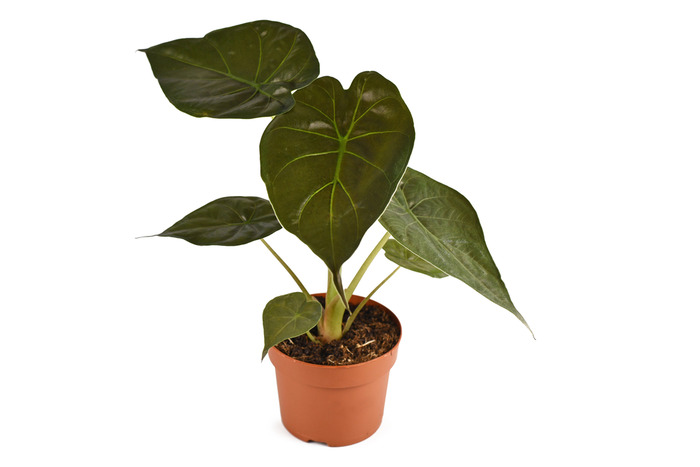

Alocasia Regal Shield belongs to the family of the flowering plant called Araceae, also known as one of the Elephant Ear plants because of its large elephant ear-like shaped foliage. This plant is a cultivar from Florida which was first grown from varieties Indigenous to Southeast Asia, Africa and Eastern Australian rainforests.
Alocasia Regal Shield is the result of mixing two unnamed plant types belonging to the species of Alocasia odora (Female parent) and Alocasia reginula (Male parent). Alocasia Regal Shield or the elephant Ear plant is an evergreen tropical perennial plant that is suited for both outdoor and indoor growing.
When they grow outdoors, the plant flowers are light green, pale yellow, or white spathe. Indoors, the environmental conditions are not as optimal as that of rainforests so usually, the plant does not flower.
So, read on as we discuss how you can grow and care for Alocasia Regal Shield in the best way possible.
Alocasia Regal Shield Quick Facts
| Plant Common Name | Neon pothos |
| Plant Botanical Name | Epipremnum aureum ‘Neon’ |
| Plant Family | Araceae |
| Annual or Perennial | Perennial, Vine |
| Plant Size at Maturity | 10 feet tall Indoors |
| Sunlight | Partial sunlight |
| Soil Type | Loamy Well-drained soil but moist |
| pH of Soil | Acidic |
| USDA Hardiness Zones | 11 a, 12a , 11 b , 12 b |
| Native Area | Africa, Australia, Asia |
| Toxicity | Toxic to pets |
How Do You Care for Alocasia Regal Shield?
Alocasia Regal Shield is a fast-growing plant when provided with the correct environment. The plant thrives in warmer climates with high humidity levels, which is extremely important for the growth of the plant.
Alocasia Regal Sheild being an elephant ear plant, like all the ones in its family, needs indirect, filtered sunlight. It can be a little tricky to create a favorable environment indoors as it needs very specific requirements for growth.
Let’s take a closer look at each of these environmental requirements.
a) Light Requirements
Alocasia Regal Shield grows at the bed of the forest floor where sunlight is filtered via a thick canopy. The plant grows well under 70% to 85% bright, indirect sunlight.
If the plant is indoors, we can replicate this light effect by placing it near a window facing either north or south, with sheer curtains or partial blinds acting as a filter.
Exposing the plant to direct sunlight can cause the leaves to burn and get browned at the edges.
b) Soil Requirements
Like the other plants in the Alocasia family, Regal Shield grows well in slightly acidic, nutrient-rich, airy, earthy, and a little moist soil.
To replicate the natural nutrient-rich soil of the Southeast rainforest, mix equal parts coco coir or peat moss, perlite, organic potting sand, or small-sized gravel.
It is essential for the soil to be well-drained in order to avoid water logging. Excess water can cause the plant to start rotting due to diseases like stem or root rot.
c) Water Requirements
Alocasia Regal Shield requires a lot of moisture to grow and thrive. The plant should ideally be watered regularly. If it is dry to touch for at least the top 2 inches, that indicates that the plant needs to be watered again.
It is crucial for the health of the plant to ensure that the moisture level is maintained at all times. Too much water can cause root rot which can very quickly kill the plant unless you let it dry in between the watering sessions.
d) Temperature Requirements
The ideal temperature range for Alocasia Regal Shield is between 68 degrees Fahrenheit to 86 degrees Fahrenheit (20 to 30 degrees Celsius).In a rainforest, temperatures can rise up to 90 degrees Fahrenheit which is why Alocasia Regal Shield can withstand high temperatures.
This is also why it’s important to maintain the temperature indoors to at least above 55 degrees Fahrenheit in order to prevent the plant from going dormant. For outdoors you can plant it ideally in USDA zones 9 to 11
Furthermore, the plant’s watering needs have to be adjusted according to the temperature. It requires more water in higher temperatures as compared to low temperatures.
e) Humidity Requirements
The ideal Humidity Requirement for Alocasia Regal Shield is between 60 to 80% but in the worst case don’t let humidity go below 40% as measured by a moisture meter. As the plant’s natural habitat is a rainforest, it enjoys a high level of humidity. Naturally, this level of humidity is not found indoors. Here are a few ways in which you can artificially increase humidity levels in your home:
You should mist the leaves regularly to provide the necessary moisture
You can keep the plant near a humidifier
Use a pebble tray under the plant pot to provide a source of evaporating water.
Humidity is one of the hardest factors to maintain and adjust.
f) Fertilizer Requirements
This is a high-feeding plant that needs to be fertilized monthly during the spring and summer times which are its growing months. Stop using fertilizers during winter and fall when the plant goes dormant. Avoid using cheaper fertilizers with high salt which may damage the plant. You can use organic fertilizers, like compost, worm castings, animal manure, or commercial fertilizers specially designed for Alocasia plants.
It is important to ensure that the fertilizers are diluted before use to avoid any fertilizer burn. You should use fertilizers by diluting them. This is very important to prevent the plant from getting fertilizer burns.
How to Propagate Alocasia Regal Shield
Alocasia Regal can be propagated easily, especially using corms. Let’s see how you can use these plantlets to propagate a new elephant ear plant
- Separate these corms from the parent plant.
- The next step is to plant the corms in a moist potting mix with proper nutrients for the plant to grow. Use equal parts peat moss and perlite as the soil.
- Place the pot so that it gets bright indirect sunlight.
- Water the pot when the soil feels dry, New roots should be seen growing in just one week.
- Ensure that the proper light, water, and temperature conditions are provided for the plant to grow.
How to Grow Alocasia Regal Shield from Seed
Although longer than the previous method, we can grow Alocasia Regal from seeds as well. As the seeds mature after a significant amount of time this process will require a lot of patience and is time-consuming.
- Take a pot filled with damp peat moss and soil that drains well.
- Spread seeds on the soil and slightly cover them. Make sure that the soil remains damp at all times. Germination can take up to 3 months.
- Once you see indications of germination move it to a place where it can get bright indirect sunlight and humidity.
- While keeping the plants in an area with bright light and humidity keeps repotting the plants as they grow.
Overwintering
During the winter months, Alocasia plants usually go dormant.
This means they do not need a lot of water. Moreover, we should withhold using fertilizers at this time of the year as well. Moreover, take care to place them near the window so they can still get as much sunlight as possible.
It is also recommended to bring them indoors if the temperature outside drops lower than 55 degrees Fahrenheit.
How to Get Alocasia Regal Shield to Bloom
Alocasia Regal Shield rarely produces flowers. Only once matured and having the right amount of humidity, temperature, moisture level, and fertilization, can they produce flowers that are white to green in color and not showy.
Even in optimal condition, it is possible that they might not flower the best you can do is follow all the ideal care requirements mentioned above and ensure that humidity is high and temperature is stable and it can surprise and bloom with flowers.
Potting and Repotting Alocasia Regal Shield
These plants are big and heavy and need a heavier pot a recommended size being 36 inches wide to anchor them and provide the necessary support. The pots used should have weight to them and they should be 1-2 inches bigger than the plant so that it allows the plant to grow.
When choosing a pot ensure that it has drainage holes so that water does not gather as this plant is very susceptible to root rot. To repot the plant turn the plant to the side and gently tap on the circumference to loosen the roots. After this slide the plant out and repot the plant in a larger pot that already has a fresh potting mix added.
Whenever repotting them, you can always separate the babies and grow them separately to allow for more space. Ensure introducing new soil whenever changing the pot. It adds more nutrients for the plant.
Alocasia Regal Shield Common Pests & Plant Diseases
Aphids, Powdery Mildew, spider mites, and mealy bugs are the common pests and diseases you will encounter with Alocasia Regal shield elephant ears.
A common disease affecting Alocasia is Powdery Mildew, which is a result of poor ventilation systems and lack of water content in the plant.
In this disease, a white powdery fungus affects the flowers, stems, and leaves. In order to avoid it, ensure that the plant is not getting under-watered.
Moreover, if the disease has spread throughout the plant, remove the infected areas and use a fungicide if needed.
Extreme temperature changes are a breeding ground for pests and insect infestation.
This is why it is important to control the surrounding temperature to ensure that the plant is growing healthily.
Bug infestation can be one of the most common causes of plant health being affected. You should regularly spray the leaves, nooks, and crannies in the plant with insecticide or neem oil spray to keep the bugs away.
Common Problems with Alocasia Regal Shield
Elephant Ears are very particular about their growing conditions. The plant will communicate with you if there is an issue with its environment. Let’s take a look at the issues that may occur if the surroundings of the plants are not in favorable growing conditions.
a) Yellowing, Wilting Leaves
This condition is a result of overwatering which can eventually be causing the root to rot as well. To remedy this, you should change the soil to a more easily drainable one and hold on watering the plant more than needed.
b) Yellowing Leaves with Webs
This is likely a result of pest infections such as spider mites. Spider mites breed in a dry and hot environment so it is very important to ensure that the temperature and moisture level are favorable to the growth of the plant depending on the season.
c) Dry Brown Spots or Edges
These are a result of a lack of water or humidity. Ensure that the plant is not near open windows or vents. You can use the humidifier to increase the humidity surrounding the plant.
Toxicity of Alocasia Regal Shield:
All Elephant Ear plants contain calcium oxalate crystals which are poisonous to animals and humans alike and can cause issues such as vomiting, skin irritation, gastronomical diseases, etc.
For Humans
Children are more likely to explore and ingest the plant which can cause a range of gastronomical issues. It is advised to keep out of reach of children.
Adults need to handle it with caution as well.
For Pets
The plant is equally toxic to animals and can cause the plant to die. In the case of pets make sure that it’s not easily accessible to them.
Frequently Asked Questions
How Fast Does Alocasia Regal Shield Grow?
Alcosia Regal shield grows at the rate of 3 to 5 feet annually when grown outdoors while indoors it grows at the rate of 1 -2 feet annually. Even though they grow up relatively faster if you grow them from seed or a very small plant they can take up to many years to reach their full height. A typical plant can grow up to 5 feet tall in 2 years. They can also grow up to 9 feet wide in the same time frame. To boost growth it’s important to provide optimal living surroundings and fertilize regularly.
Should You Mist Alocasia Regal Shield?
This plant requires a lot of moisture and humidity. Misting is beneficial to provide the plant with the required moisture content. Misting the leaves also makes them appear healthier, greener, and fresher.
In case misting is not enough, place a humidifier nearby to provide accurate moisture content.
Can I Grow Alocasia Regal Shield Indoors?
This popular breed can grow both indoors and outdoors. These plants grow up really tall and really wide due to which it is extremely important to provide them with enough space so they grow without any hurdles.
Ideally, we need to mimic the natural conditions so that the plant has the optimal environment to grow beautifully.
How Tall Does the Alocasia Regal Shield Grow?
Alocasia Regal Shield is a huge plant that can grow up to 6 feet tall and 9 feet wide. A single leaf can grow up to 20 inches wide. These huge plants add to the beauty of your place indoors.
Does Alocasia Need Lots of Sun?
Alocasia grows under bright but indirect sunlight. They need around 70%-90% of sunlight.
To mimic the sunlight filtered through the canopy in a rainforest, we should place them in front of windows facing south or north. You can use sheer curtains or window film to filter the light.
We need to avoid exposing the plant to direct sunlight or it might scorch it.
Is Alocasia Good for Indoor Plants?
Alocasia is a fantastic indoor plant. Its unique foliage adds to the beauty of the place which is why it is popular as a houseplant. Once we create the conditions which are favorable to the growth of the plant then they are easy to look after.
They can grow very efficiently indoors in pots with the minimum changes in natural humidity levels.
What is the Lifespan of an Alocasia?
An Alocasia plant can live up to 5 years if cared for properly. The good news is that the plant propagates pretty frequently which it is very easy to get newer plants all the time.
Providing optimal surroundings is directly related to how long the plant can thrive indoors.
Does Alocasia Need Big Pots?
The size of the pot depends on the size of the Alocasia plant typically opt for 36 inches wide container for alcosia plants so that it has room to grow. If you grow the Alcosia elephant ear plant in a larger pot it has room to grow to a larger size so I recommend large pots
Every couple of months, a smaller plant needs to be repotted into a bigger plant.
Ideally, the newer pot should be 1-2 inches bigger so that there is enough space for the plant to continue growing.
Trusted Citations & Sources Used
Articles on Itishomegarden are thoroughly researched and fact-checked using trusted resources to ensure that they are relevant and accurate
- Alocasia (Elephant’s-Ear, Giant Taro) | North Carolina Extension Gardener Plant Toolbox. (n.d.).
- USPTA Alocasia Plant Named Regal Shields
- Surhone, L. M., Tennoe, M. T., & Henssonow, S. F. (Eds.). (2010). Alocasia. Betascript Publishing.
- Surhone, L. M., Tennoe, M. T., & Henssonow, S. F. (Eds.). (2010). Alocasia. Betascript Publishing.
Also Read
How to grow Calathea Warscewiczii
Neon Pothos Growth & Care guide
Ficus Elastica Tineke Care & Growth Guide