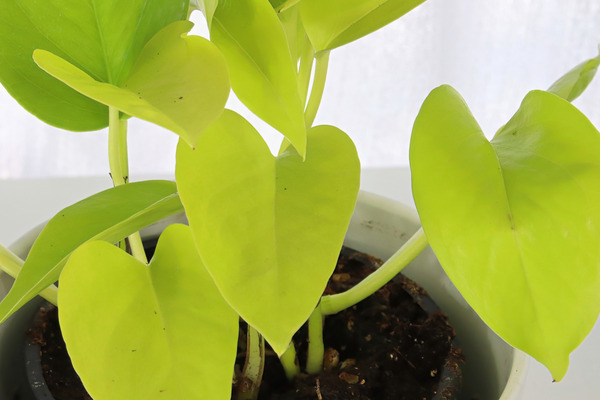

Neon pothos is a beautiful, bright-green plant that flaunts lovely, heart-shaped leaves along trailing vines. Neon pothos originated in the tropical climate of the Solomon Islands, and today are used as perennial evergreen houseplants. Due to their origins, they prefer warm temperatures and plenty of indirect sunlight. Neon pothos is a member of the Araceae family and is commonly grown for its beautiful, green foliage that grows on cascading vines. Its vines can grow up to around 10 feet in length. Neon pothos is an easy houseplant to care for, making it great for beginners, as well as those who tend to forget about their houseplants. Its tropical origins make it drought tolerant and it can adapt to low light levels, making this the perfect houseplant for any home.
Neon Pothos Quick Facts
| Plant Common Name | Neon pothos |
| Plant Botanical Name | Epipremnum aureum ‘Neon’ |
| Plant Family | Araceae |
| Annual or Perennial | Perennial, Vine |
| Plant Size at Maturity | 10 feet tall Indoors |
| Sunlight | Partial sunlight |
| Soil Type | Loamy Well-drained soil but moist |
| pH of Soil | Acidic |
| USDA Hardiness Zones | 11 a, 12a , 11 b , 12 b |
| Native Area | Asia |
| Toxicity | Toxic to pets |
How Do You Care for Neon Pothos?
Neon pothos is a low-maintenance houseplant, meaning that it is easy to take care of. They can handle wide range of light conditions and are tolerant of you forgeting to water them once in while also pruning is not strictly necessary for them but you can still do it once in a while since they can grow upto 10 feet tall. All these traits make them an easy houseplant and now lets look at individual requirements for caring for neon pothos.
1. Light Requirements
Neon pothos needs anywhere from 6 to 12 hours of bright, indirect sunlight a day to grow their best. Neon pothos thrives in bright light but be sure to keep it away from direct sunlight because it can cause neon pothos’ delicate leaves to turn yellow or even burn. Neon pothos can adapt to many different lighting conditions, including lower light situations. They grow well under artificial light, so this makes them a great choice for bedrooms, bathrooms, or offices, which oftentimes don’t receive much natural light. When keeping your neon pothos in places with lower light, remember to keep an eye out for things like leggy growth, brown tips, or fading or variegated colors. These are all indications that your neon pothos may not be receiving enough light.
2. Soil Requirements
Neon pathos grows best in loamy ,well-draining soil that is moist with an acidic pH and is rich in nutrients. Neon pathos’ roots need well-aerated to help ensure they stay dry to avoid root rot. The soil also needs to be able to retain enough moisture so your pathos doesn’t dry out too quickly. You can mix your own potting soil by blending general garden soil, peat moss or coconut coir, perlite, and vermiculite. Using general garden soil as your base, mix in peat moss or coconut coir for added drainage, aeration, and organic matter. Organic matter will break down and be used by your plant for nutrients. Perlite is a volcanic glass that is added into potting soil blends to help aid in aeration and prevent soil compaction. Like perlite, vermiculite is also a form of volcanic matter that is used for aeration, but it can retain moisture as well. Vermiculite resembles Styrofoam when added to the potting mix. Mixing your own potting soil allows you to control the different features needed in a soil blend, such as the soil’s moisture-retaining abilities, aeration, and drainage.
3. Water Requirements
In general, it’s a good idea to only water neon pathos when the top few inches of the soil feel dry to the touch. Letting neon pathos’ soil adequately dry out between watering will help prevent root rot, a disease that is caused by continuously moist soil and which neon pothos is most susceptible to. Smaller pots need about a cup o two of water when dry, and larger pots can require up to six cups. When watering neon pathos, the goal is to water it enough that the water seeps through the drainage holes of your pot. You can avoid overwatering by ensuring the pot or container has proper drainage holes, using well-draining soil, and incorporating organic matter into the soil such as sphagnum moss, tree bark, or compost. This will help your soil retain the moisture it needs while providing proper drainage.
4. Temperature Requirements
Neon pathos was originally found on various tropical islands in the Pacific Ocean, so you can bet that it’s comfortable in warmer temperatures. They can live in temperatures ranging from 55 to 90 degrees Fahrenheit (15 to 35 degrees Celsius). This makes them an ideal houseplant because most people are comfortable with a room temperature of about 70 degrees Fahrenheit. Neon pathos struggles in environments that are 55 degrees and below, but it can survive in them for short periods. Keep this in mind if you keep your neon pothos on or near a windowsill during the winter, because it can get too cold for them to survive.
5. Humidity Requirements
Neon pothos like higher humidity levels, around 50%. Again, this is because of its roots in warm, humid climates. Many people find that the normal humidity levels in their homes are adequate enough for their neon pothos to thrive, so as a beginner, you probably won’t need to worry about it too much. If you knowingly live in a drier climate, a few ways to add more humidity into the air is by using a humidifier, placing a tray of water under or around your neon pathos, or even grouping multiple houseplants together, which adds a collective humidity. Again, unless you live in a very dry climate, most of this won’t be necessary as long as your neon pothos is adequately watered. A few signs that the humidity level is too low for your neon pothos include the appearance of brown on the tips of the leaves, crispy or dry leaves, or yellowing leaves that fall off.
6. Fertilizer Requirements
Neon pothos doesn’t require much in the way of fertilizer, but if you want to increase growth and ensure a healthy, foliage-rich plant, it will benefit from balanced liquid fertilizer once a month during its growing season, the spring and summer months. If you use nutrient-rich potting soil with added organic matter (such as peat moss, coconut coir, or compost) when potting your neon pathos, there is little to no need to fertilize it. Organic matter will decompose and break down over time, providing your neon pothos with plenty of nutrients. If you wish to add extra fertilizer, choosing fertilizer that is high in nitrogen will help promote healthy foliage growth.
7. Pruning Neon Pothos
The bright-green, leafy vines of the neon pathos plant can grow from 6 to 10 feet long indoors. If you notice that the leaves are spread out very far and your neon pathos is becoming leggy, then it may be time to prune it. I know pruning can be a scary word, but when you cut the vines off of your neon pothos plant, you can easily propagate them to grow new plants. Trim off any vines that are excessively leggy or that have leaves that are spaced very far apart. To prune your plant, use sharp shears to cut the vine ¼ to ½ inch above the spot where you can see the leaves protruding from the vine. You can also remove any yellow or dry, crispy leaves when pruning your neon pothos.
How to Propagate Neon Pothos from Stem Cuttings
Now that you’ve learned how to care for your neon pothos, you can take cuttings from pruning to propagate more neon pothos plants. And who doesn’t want a house full of these beautiful, vining plants? One of the most amazing aspects of the neon pothos is the ease with which it propagates. Below, we’ve provided you with a quick, step-by-step guide to help you propagate neon pothos from stem cuttings.
1. After you’ve pruned any scrawly vines, locate the nodes. The node is the spot where the leaves meet the vine. You’ll notice little black knobs near the nodes; these are the aerial roots, the place where the new roots will grow from.
2. Using sharp shears or scissors, cut about ½ inch above and below the nodes. You can keep the leaf attached to your cutting to help monitor it while it is growing new roots, but it isn’t necessary.
3. In a small pot or container, add a potting soil blend and moisten it.
4. Place the cutting directly in the soil (up to the top of the node), making sure the aerial root is covered.
5. Press the soil down around your cutting to ensure it stays in place.
6. Moisten the soil around your cutting, and ensure it stays moist through the first few weeks.
7. Place your new plants in a warm, sunny area away from direct sunlight. Keep the soil moist, not wet, during the first few weeks.
8. It will take a few weeks for the roots to start forming. To check if roots are forming after a couple of weeks, gently tug on the plant near the base. If you feel resistance, then there are roots.
9. When you are confident that you have established roots, you can start letting the soil dry out between watering.
10. If you want a fuller neon pothos plant, you can propagate multiple cuttings in the same pot. This will result in a plant that fills an entire pot, versus a single vine growing from the pot.
Common Pests and Diseases
Another reason neon pothos is considered low maintenance is that they aren’t susceptible to many pests and diseases. The main disease that neon pothos face is root rot, which is usually the result of overwatering or poor drainage. To avoid root rot, wait until the soil has dried out before watering. Ensure that you provide well-draining soil and that your pot has proper drainage holes.
Pests that may affect your neon pothos include common houseplant pests, such as spider mites, scale bugs, aphids, white flies, and mealybugs, which all like to suck the sap from houseplants. A good way to treat many of these pests is to utilize neem oil. Spray or rub neem oil on the leaves of your neon pothos to keep pests away; it will also give the leaves a beautiful shine.
Fungus gnats can also be a big problem, but if you let the soil of your neon pothos dry between watering, likely, they won’t survive. Another common remedy for common houseplant pests is to sprinkle a little cinnamon on the soil. The cinnamon repels many types of flies, gnats, mites, and aphids, and gives off a great smell.
Toxicity of Neon Pothos
Although it flaunts beautiful, bright-green leaves resembling elongated hearts, neon pothos is very poisonous. This plant is completely inedible, and it is toxic to humans and pets alike. We recommend pruning your neon pothos with great caution and keeping it out of reach of small children and pets. Also, keep an eye out for any loose leaves that may fall off the vine when watering or moving your neon pothos.
1. Is Neon Pothos Poisonous to Humans?
Neon pothos is poisonous to all humans; adults and children alike. The main reason for this is that neon pothos contains insoluble calcium oxalate, which can build up in your digestive system and cells. Insoluble calcium oxalate will crystalize as it builds up and is comparable to tiny slivers of glass. Although death is uncommon, symptoms of poisoning by neon pothos include swelling of the mouth, tongue, and lips; vomiting; burning sensations in the mouth; and breathing problems [1].
2. Is Neon Pothos Toxic to Cats?
Neon pothos is toxic to all pets, including cats and dogs. The symptoms of your pet ingesting neon pothos include oral irritation, excessive drooling, vomiting, burning in the mouth,lips and tongue , and difficulty in swallowing[1]. Keep neon pothos out of reach of all pets, especially cats, since they are curious and can climb anything. Pets can’t consume insoluble calcium oxalates for the same reasons as humans, so be extremely cautious if you plan on growing neon pothos with pets around.
Common Problems with Neon Pothos
Although neon pothos is very tolerant, there are a few things to look out for when caring for them that can indicate some sort of problem with your plant. These include:
1. Drooping Leaves
The most common reason for drooping or wilting leaves in neon pothos is dry soil. Drooping leaves are usually a sign that it’s time to water your neon pothos. It is common practice among many home gardeners to wait until the soil is dry and the leaves start to droop before watering to ensure that the soil has dried out. So, to remedy drooping leaves, check the moisture in the soil. Most of the time, a good watering will bring your leaves back to life.
2. Brown Tips
If you notice brown tips forming on your neon pothos, check the humidity in the air or see if you are underwatering the plant . Being of tropical origins, neon pothos thrives in high humidity and if humidity is the problem you can move the plant to kitchen or bathroom to increase humidity easily. If the problem is underwatering try watering your plant more often and see if it makes a difference
3. Leggy Growth
If your neon pothos is showing leggy growth, meaning the vines are long noticeably long and is producing fewer leaves, this is a sign that the plant’s sulight needs aren’t being met. Leggy plant growth in neon pothos is often due to inadequate light levels. Try moving your plant to a place that gets brighter, indirect sunlight. Leggy growth may also be a signal that it’s time to replant your neon pothos. When their roots become rootbound, they will grow long, spindly vines. To remedy this, simply replant your neon pothos in a bigger pot.
Frequently Asked Questions
1. Why does my neon pothos have patches of darker green variegation?
Neon pothos’ that aren’t getting an adequate amount of light may show patches of darker green variegation. Consider moving your neon pothos to a well-lit area. Small patches of darker green can also be due to a gene mutation.
2. Should I use a moss pole or trellis for my neon pothos?
It is better for Neon pothos to grow on a moss pole then on a trellis though you can use both a moss pole or a trellis to support the vines but it would be better on a moss pole.
3. Can neon pothos grow in just water?
You can grow neon pothos in water alone, if you fertilize the water. It is best grown in water when propagated from cuttings to avoid root rot.
4. Does neon pothos grow fast?
In my experience Neon pothos is a moderate to fast growing plant and if provided with good growing conditions, neon pothos can grow few inches every month while if placed in lower light or temperature the growth will be slower
5. Should I mist my neon pothos?
While misting your neon pothos can slightly increase the humidity level, there is no need to mist the plant. It does best when watered only when the soil feels dry.
Trusted Citations & Sources Used
Articles on Itishomegarden are thoroughly researched and fact checked using trusted resources to ensure that they are relevant and accurate
Also Read
How to grow Calathea Warscewiczii
Alocasia Regal Shield Care Guide
Ficus Elastica Tineke Care & Growth Guide