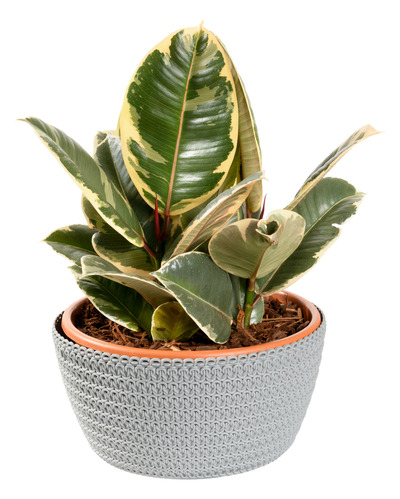

Variegated Rubber Plant (Ficus elastica Tineke) is a popular and easy-to-grow tropical houseplant that is native to Asia. The Variegated rubber plant has glossy green leaves which stand out when planted indoors. The rubber plant is best grown in places that remain warm and humid throughout the year and it can serve as a colorful ornamental plant grown in your yard or indoors. Ficus elastica is known as a weedy thug because it grows so fast due to its fast-spreading roots when provided with the right conditions. It is best suited to USDA hardy zones 10 to 12.
Ficus Elastica Quick Facts
| Plant Common Name | Ficus Tineke, Variegated rubber plant |
| Plant Botanical Name | Ficus elastica ‘Tineke’ |
| Plant Family | Moraceae |
| Annual or Perennial | Tree, Perennial |
| Plant Size at Maturity | Outdoors 30 feet , Indoors 2–10 feet tall |
| Sunlight | Partial sunlight |
| Soil Type | Well-drained soil |
| pH of Soil | Acidic, Neutral |
| USDA Hardiness Zones | 10-12 |
| Native Area | Asia |
| Toxicity | Toxic to pets |
How Do You Care For Ficus Elastica Tineke?
Caring for Ficus elastica is very easy if you are able to provide it with the right light making it the best low-maintenance plant for a beginner gardener. Along with the right light if you dust the leaves of the houseplant and rotate the pots you will be easily able to maintain its beautiful variegation.
a)Light Requirements
The Ficus elastica Tineke will grow best in medium to bright indirect light which is similar to the light that is found in its native conditions in the forest in the tropics. For the Rubber plant, it is important to have a balance in sunlight offered as too much light can actually damage the plant by scorching it while too little light will cause the pink hues on the plant to fade. Too Little Light can also cause other problems like making it leggy and having less leafy growth so a balance in light is essential for maintaining its natural variegation.
Ideally, you should place the Ficus elastica houseplant in a window facing east or if that is not possible then you should place it in the back of a west or south-facing window.
b) Soil Requirements
Ficus elastica Tineke needs a loose but well-drained potting mix as it is not fussy about the soil. Ideally, the rubber plant thrives in an acidic environment when it comes to the soil so planting it in a cactus potting mix gives good results.
c) Water Requirements
Depending on the light and humidity Ficus Tineke needs to be watered once every one to two weeks during its growing season in summer. Be careful to let the soil dry out between waterings especially a couple of inches on the top.
Ideally, you should underwater the plant rather than overwater the plant as they like to be in light moisture conditions consistently but be careful not to leave them too dry. Also, take care not to leave the plants standing in water as that may cause root rot and damage the plants. Also when watering the plant be careful that you don’t drip on the leaves else the leaves may stain.
d) Temperature & Humidity Requirements
Ideally, Ficus Elastica Tineke requires temperatures between 60 to 75 degrees Fahrenheit to grow well. If your home has a temperature below 50 degrees Fahrenheit or above 90 degrees Fahrenheit regularly then you should not grow this plant. Being a Tropical plant Ficus Elastica Tineke prefers high temperatures and moderate humidity. You have to be careful and not position this plant near AC ducts or places where it can feel draughts also if your home faces sudden temperature drops then this plant will not do well.
e) Fertilizer Requirements
Ficus Elastica Tineke needs to be fed liquid fertilizer every couple of weeks during summer which is the growing season. Take care to ensure that fertilizer is weak as anything strong will cause the plant to be root bound and have a straggly growth. During winters Ficus Elastica doesn’t need any kind of fertilizers.
Pruning
It is a fast-growing plant, so you should prune it occasionally so that you can keep it in shape. Try to trim off leaves that look unhealthy and out of shape while if you cut off healthy leaves then use them to propagate new plants. Pruning helps in the development of new foilage and reduces the leggy growth as well as keeping the plant in shape.
How to Propagate Ficus Elastica Tineke By Stem Cuttings
Here are steps to propagate and root Ficus Elastica Tineke from stem cuttings do take care to do the propagation in spring during the growing season so that you have a better chance of success.
- Cut a 6-inch stem from your plant, taking it from a stem that is healthy and has at least 4 leaf nodes.
- Ensure that you remove leaves from the bottom but there is at least 1 leaf at the top so that all the energy is directed towards new growth instead of towards the leaves.
- Place the cutting in a well-drained container filled with a well-drained organic potting mix all the while ensuring that the top leaf node is above the mix.
- To Ensure that Humidity is high during rooting put a plastic bag that is completely sealed over the potting but is not touching the cutting you can add a chopstick over it to achieve that
- Keep the temperature between 65 and 75 degrees Fahrenheit while waiting for roots to form on your Ficus Elastica Tineke plant cuttings.
- It will take over a month for the roots to take up hold in the soil and you will get to know if propagation has happened if you feel resistance when you try to pull the cutting
You can also propagate the Ficus Elastica Tineke using air layering
Ficus Elastica Tineke in Containers: Potting and Repotting
Ficus Elastica Tineke is a very fast grower so you need to repot them once or twice a year. Whenever Rubber plant roots start coming out of drainage holes it is time for you to repot these plants. To repot these plants you need to choose a pot that has a larger diameter in size but only by a few inches as a pot that is too larger in size can cause moisture retained to be higher which can in turn lead to soggy roots which is a major problem. These plants also have roots that spread so much that they fill the pot so you have to be careful. When doing the repotting by filling the potting mix ensure that you leave a couple of inches at the top free for watering.
Toxicity:
Is Ficus Elastica Tineke Poisonous to Humans
Yes, ficus Elastica Tineke is poisonous or toxic to humans due to the latex present in the sap. While mostly it is considered a low-toxic plant but for some people who are allergic to latex it can become life-threatening so try to keep it away from children.
Are Ficus Elastica Tineke Toxic to Cats
Yes, ficus Elastica Tineke is toxic to cats and other pets because of the latex present in the sap so try to keep it away from them. Most pets can face gastrointestinal problems or irritation in the mouth after eating this but for some, it can cause serious problems like organ failure so consult a doctor if you face this problem. This can also be irritating to the skin of some pets.
Common Problems With Ficus Elastica Tineke
Unless the Ficus elastica Tineke plant is neglected or is facing not optimal conditions you will not face any issues. The following are some of the common problems:
Leaves Turning Yellow
If the leaves of your plant are turning yellow it could be either due to overwatering the plant or due to the fact that it is placed somewhere it is facing gusts of cold air. The best solution to overwatering problem is to always check if the top 1-2 inches of soil feels moist if before watering it does so then wait for a few days and check and then water the plant.
Plant Leaves Falling Off
If you see Ficus Tineke plant leaves falling off it is a classic case of underwatering. Do Note that some of amount of plant leaves falling is natural but mostly it would be lower leaves dropping off so that energy can be focussed on newer growth but if you are seeing premature leaf drop of newer growth then it is a case of underwatering and you need to change the schedule with which you water your plant. Between Two rounds of watering you should make sure that your potting mix has not dried out and if it has done so then you should update your watering schedule.
Brown Tips
If you find brown tips on your ficus Tineke then it is because of too much direct sunlight which has made your leaves crispy and brown. The best solution to this problem is to move your pot so that your houseplant gets spotty sunlight which is indirect.
Frequently Asked Questions
Here are some of the frequently asked questions:
What is the Best Fertilizer to Use on Ficus?
Ficus Elastica Tineke needs to be fed weak liquid fertilizer or water-soluble fertilizers every couple of weeks during summer. Do not fertilize the plant when it is dormant and during winters
What is The Best Way to Water Ficus?
The best Way to Water Ficus Tineke or variegated Rubber plants is to water them once every one to two weeks during their growing season in summer. You leave it underwatered during winter.
Does Ficus Tineke Grow Fast?
Ficus Tineke or variegated Rubber Plant can grow very fast up to 24 inches every year. You can see them grow up to 10 feet indoors and even more outdoors given the optimized set of care conditions.
How Long Can My Ficus Tineke Live?
Your Ficus Tineke or variegated Rubber Plant can live for a few decades if you look after it well. When left to grow outdoors they can even live up to 100 years.
Why is the Variegation Fading on My Ficus Tineke?
The pink variegation on a ficus Tineke can fade due to the fact that the plant may not be getting the amount of sunlight it needs. While direct sunlight can also harm these plants but too little sunlight can cause these pink hues to disappear so try to find a balance by placing it in a way it gets spotty or patchy sunlight.
Trusted Citations & Sources Used
Articles on Itishomegarden are thoroughly researched and fact checked using trusted resources to ensure that they are relevant and accurate
Pet Poison Helpline on toxicity
Also Read
How to grow Calathea Warscewiczii
Alocasia Regal Shield Care Guide
Neon Pothos Growth & Care guide