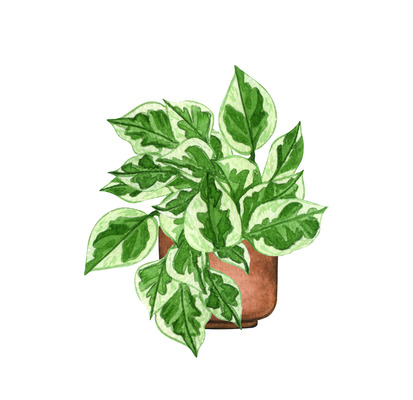

Pearls and Jade Pothos (Latin name: Epipremnum aureum) belong to the family of Araceae plants. It is famous as an indoor houseplant. This is a tree-climbing species that is naturally found in the Solomons islands, French Polynesian islands, South Asia, Pacific Islands, and more places with a tropical climate. Pearls and Jade Pothos came from mutation done by the University of Florida researchers on marble queen pothos. Pearls and Jade Pothos have smaller and thinner leaves than golden pothos and marble queen pothos
Pothos has multiple more commonly known varieties such as devil’s ivy, golden pothos, and jade pothos. However One of the most popular types of pothos is the “pearl and jade pothos” which is used either as a mini potted plant or in a hanging basket.
They have patterned leaves in grey, white and cream color. Their variegation makes them a beautiful addition to the home. Some not most also produce green and white flowers usually with the help of an artificial stimulant but mostly its flowers rarely bloom indoors
Pearls and Jade Pothos Quick Facts
| Plant Common Name | Pearls and jade pothos |
| Plant Botanical Name | Epipremnum aureum ‘Pearls and Jade’ |
| Plant Family | Araceae |
| Annual or Perennial | Perennial |
| Plant Size at Maturity | 6 feet to 10 feet tall and wide Indoors |
| Sunlight | Partial sunlight |
| Soil Type | Well-drained soil but moist |
| pH of Soil | Acidic |
| USDA Hardiness Zones | 9,10,11,12 |
| Native Area | French Polynesian islands, Pacific Islands |
| Toxicity | Toxic to pets |
How Do You Care for Pearls and Jade Pothos?
Pearl and Jade pothos are easy to take care of. They grow indoors beautifully Being a climber, they can grow up to 6-10 feet on average. However, under optimal conditions, they can grow up to 30 feet as well.
This species of plants take their time to reach their full potential. Let’s check out the environmental conditions needed for the plant to thrive and sustain indoors.
a) Light Requirements
Providing this plant with accurate lighting is very important. Pearls and Jade Pothos thrive in indirect, bright sunlight. Moreover, you need to expose the plant to this type of sunlight for several hours. It can survive in lower light but it will see lower growth and a decrease in variegation and they don’t take low light as well as jade or golden pothos.
Ideally, you can keep them in windows facing east or north. Otherwise, keep them a little bit further away from the west or south-facing window or introduce a barrier like a sheer curtain or a window pane.
This plant has leaves that are as thin as paper. What this means is that exposing it to direct sunlight can cause them to burn immediately.
Inconsistencies in the type and duration of lighting can also cause differences in the variegation and pattern of the plant.
b) Soil Requirements
Pearls and Jade Pothos plant requires a simple potting soil that is lightweight, well-drained, and airy which should do the trick.
A mixture made up of equal parts of perlite, potting soil, and orchid bark provides an ideal growth stimulant for this species of pothos.
The soil should remain moist but not soggy. Soggy soil can cause root rot and in turn damage the plant.
c) Water Requirements
Jade and Pearl pothos should be watered once a week during Spring and Summer when there is higher heat and more sunlight. In winter, you can go up to watering once every 2 weeks easily. You should test the moisture of the soil with a moisture meter before watering the plant If the top 2 inches of the soil is dry that indicates that the plant needs to be watered.
Jade and pearl pothos follows the watering needs of all other pothos plants that thrives naturally in an area with high rainfall. Despite this, the plant can actually withstand droughts.
With Jade and Pearl pothos we need to be careful to ensure that we do not overwater the plant and cause the soil to become waterlogged. It can cause severe damage to the roots of the plant and can lead to the plant dying.
d) Temperature Requirements
As these belong to a specie of tropical plants it’s best to provide them with a hotter, warmer climate. The normal household temperature should do well if you are living in areas located near the Equator.
In colder places, you need to ensure you have the temperature artificially adjusted so that they are not placed somewhere that has a temperature below 50 degrees Fahrenheit.
If you live in a warmer climate in USDA zones 9 to 11 you can even grow these plants outdoors otherwise these are more popular as a houseplant
e) Humidity Requirements
Jade and Pearl pothos grow in a humid environment. Naturally, the existing humidity of a warmer climate region should be more than enough. However, if your house is on the drier side, you can use a humidifier or simply spray the plant leaves with water to provide enough moisture so the plant does not dry out.
f) Fertilizer Requirements
Like any tropical plant that grows during Spring and Summer time and is stagnant during Fall and winter seasons, fertilization should only be done during the growing seasons.
The best fertilizer to use is a commercial-grade liquid fertilizer suitable for indoor plants. You should fertilize monthly as that is enough for this type of pothos.
Maintenance & Pruning
Pearl and Jade Pothos do not necessarily require maintenance as much. However, in order for it to give an appealing look it’s beneficial to trim out of hands growth to give it a cleaner look.
Make sure that the pruning is done during Spring and Summer seasons when the plant is growing. Always use a sterilized scissor in order to avoid any fungal or bacterial infections. Moreover, make sure that at any given time no more than one-third of the plant is trimmed or cut.
How to Propagate Pearls and Jade Pothos From Stem Cuttings
Even though these plants grow very slowly, it’s one of the easiest plants to propagate. This should ideally be done during Spring and summer times when the plant is continuously growing. This will yield faster results. Let’s see how you can propagate this specie of plant using its stem cuttings.
- Take a piece from a healthy stem that has around a minimum of 3-5 buds. We should cut it with a sanitized tool.
- Remove a few leaves from the bottom of the stem. This will expose the lower buds.
- Submerge the lower nodes of the stem cuttings in water with the top of the cutting above water. Place it under bright, indirect sunlight.
- Change the water every week. Check on the cutting, you will notice white roots will start growing after a couple of weeks.
- Once they are 3-4 inches long transfer the cuttings to the soil. Ideally use a pot with drainage holes. User well-draining, airy soil.
- Expose the plant to the same bright, indirect sunlight. Ensure that the soil is moist in the initial 1-2 weeks. It should not be dry at any time.
- After 2 weeks you can start watering the soil only when the top 2 inches are dry.
Potting and Repotting Pearls and Jade Pothos
Repotting the plant is necessary as the original potting soil might be overused. It’s always beneficial to introduce fresh potting soil as it brings new nutrients to the plant.
Pothos needs to be repotted if you can visibly see the roots overgrowing the pot or if you notice that the growth of the plant has stopped.
Ideally every 1-2 years you should check on the plant to see if you need new soil or a bigger pot.
Whenever reporting make sure it is in the growing season. Furthermore, make sure that the new pot is 2-4 inches bigger so it allows for the plant to grow bigger.
Pearls and Jade Pothos Pests & Plant Diseases
Pothos are not known to be disease-ridden or a plant that gets infected actively. However, if proper care is not done it can be attacked by some common house pests.
Fungus, thrips, and mites are some of the pests which can actually spread from other plants nearby. Also like most houseplants, it is also susceptible to root rot if overwatered.
You need to make sure that you are regularly examining the plant and cleaning all the nooks and crannies to avoid any bug infestation.
Alternatively, if there is a bug infestation, you can use plant-safe insecticide spray to clean your houseplant.
Common Issues With Pearls and Jade Pothos
When planting indoors, a lot of environmental factors can cause issues with the growth and appearance of the plant. That is why it is so important to make sure that you provide the ideal conditions for the plant to grow in.
a) Yellowing, Wilting Leaves
Leaves turning yellow can be a result of a number of environmental discrepancies. From excess water or lack of water to Too much sunlight or too little sunlight. Any of these inconsistencies can cause the leaves of the plant to lose their shape and color.
Comparatively, it is important to also notice when this color change is happening. Naturally, near the fall the leaves will start to change color as part of their life cycle. In case the plant overall looks healthy then there is probably no reason to worry.
b) Brown Leaves or Spots
Leaves turning brown is actually a clear indication that the plant is dehydrated. It can be because you are not watering the plant enough or because the humidity levels in the air are less than optimal.
Make sure that you are consistently watering the plants so they are not drying. If the weather is on the drier side you can increase the humidity levels by spraying the plant with water or keeping it near a humidifier.
c) Drooping Leaves
If your plant is not getting enough water the first indication is that its leaves will start to droop. This isn’t a big issue. In reality, it’s actually ideal to water the plant when you notice it drooping, just to ensure you aren’t overwatering it.
However, leaving it to droop for a longer period of time can lead to other issues like brown leaves which might not be as easy to come back from.
d) Curling Leaves
If your leaves are starting to get heavy and curl that means that your plant has root rot. There can be a number of reasons for the roots to start dying. The most common reasons are either you are exposing the roots to too much water or You are using denser and heavier soil. Both issues cause the soil to become waterlogged which is the main reason the roots rot.
In such cases, just ensure the type of soil used is correct and hold back a little on watering the plant frequently.
Toxicity of Pearls and Jade Pothos:
All plants in the Epipremnum genus are considered toxic. This is toxic mostly when pets and children who are at a higher risk of being exposed to it ingest it.
For Humans
Because of the presence of calcium oxalate crystals, it is toxic if ingested. It can also cause skin irritation in case you are highly sensitive.
It’s not the most toxic plant for humans as these are usually kept higher up and the chances of being ingested by toddlers or adults are very unlikely.
For Pets
This plant is toxic to animals and can cause GI Tract issues if ingested. As it is a climber it would ideally look nicer out of reach of your furry friends.
Pearls and Jade Pothos vs Marble Queen Pothos & Manjula Pothos
Pearls and Jade Pothos have smaller and thinner leaves than golden pothos and marble queen pothos and Manjula pothos. The variegation pattern of Pearls and Jade Pothos has accents of green and splotchy which is different than that of Manjula pothos which has more white areas while marble queen pothos has more striking green areas.
Frequently Asked Questions:
Aren’t Pearls and Jade Pothos and N’joy Pothos the Same?
They are from the same species but both the pothos are different in terms of how they look.
Pearl and jade pothos have narrower leaves with a green and white pattern on them. The n’joy pothos has wider leaves and the pattern only has the color white in it, not green.
How Huge Can Your Jade and Pearl Pothos Get?
In its native habitat, the pearl and jade pothos can grow up to 30 feet tall. This is because they are being provided with the best and optimal conditions all year around.
These plants, indoors, can grow up to 6-10 feet, where these factors have to be artificially manipulated. This is less than ⅓ of their actual potential.
How Can I Make My Specie of Pothos: Pearl and Jade, Thicker?
To make your pearl and jade grow thicker you need to prune these plants and make sure that these plants are exposed to enough sunlight in order to boost their luscious growth.
Trimming them regularly, whenever needed will also help the plant to grow more thicker and luscious. So if you want your plants to have a fuller look just ensure that you are taking care of their maintenance and pruning them whenever needed (only during growth seasons).
How Fast Do Pearl and Jade Pothos Grow?
As compared to the other plants in the pothos specie, Pearl and jade pothos relatively grow slower. It can grow up to 6 inches per vine over the whole year if provided with the best environmental conditions around.
Once it reached 6 feet and above the plant grows more slowly or stops growing altogether.
Trusted Citations & Sources Used
Articles on Itishomegarden are thoroughly researched and fact checked using trusted resources to ensure that they are relevant and accurate
- https://journals.ashs.org/hortsci/view/journals/hortsci/44/3/article-p824.xml
- https://edis.ifas.ufl.edu/publication/EP441
Also Read
How to grow Calathea Warscewiczii
Alocasia Regal Shield Care Guide
Neon Pothos Growth & Care guide
Ficus Elastica Tineke Care & Growth Guide