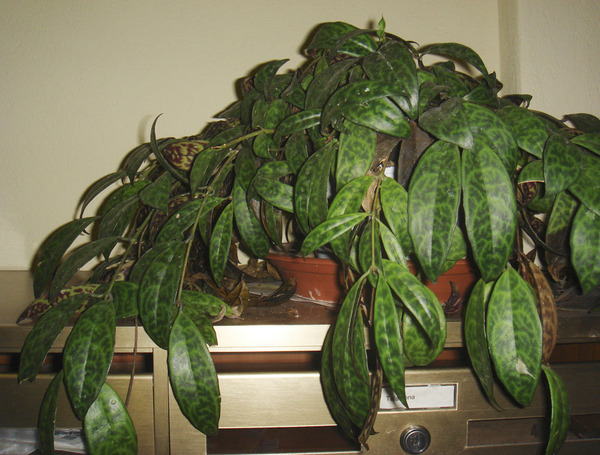

Black Pagoda Lipstick Plant also known as Aeschynanthus longicaulis or zebra basket vine is a beautiful plant that looks like the Hoya plant but is a variety of lipstick plants. It is native to South East Asia and grown primarily in Thailand, Vietnam, and Malaysia and comes from the Gesneriaceae family and does really well as a houseplant indoors. In this piece, we will take a look at how to grow and care for Black Pagoda Lipstick Plant
Black Pagoda Lipstick Plant Care Quick Facts
| Plant Common Name | Lipstick Plant ‘Black Pagoda’, Zebra Basket Vine |
| Plant Botanical Name | Aeschynanthus longicaulis |
| Plant Family | Gesneriaceae |
| Annual or Perennial | Perennial |
| Plant Size at Maturity | 12 to 24 feet tall and 1 to 2 feet wide |
| Sunlight | Full Shade or Partial sunlight |
| Water | Only Water when the soil is dry |
| Soil Type | Chunky Well-drained soil, Aroid Mixture |
| pH of Soil | Acidic to Neutral (6.1 to 7.5) |
| USDA Hardiness Zones | 10,11 |
| Blooms | Orange, Yellow, and Red flowers |
| Native Area | Thailand, Vietnam, Malaysia (South East Asia) |
| Toxicity | Not Toxic to humans or pets |
Takeaway: Black Pagoda Lipstick Plant Care
For growing Black Pagoda Lipstick Plant you need to provide 5 to 6 hours of bright but indirect sunlight chunky but well-draining soil and water only when the top 2 inches of soil is dry. Black Pagoda Lipstick Plant grows well in USDA hardiness zones 10 and 11 and in temperatures ranging from 65 to 85 degrees Fahrenheit.
How Do You Care for Black Pagoda Lipstick Plant?
Black Pagoda Lipstick Plant is an easy-to-grow plant that is primarily grown as a houseplant as it is not winter hardy and is great to grow in hanging baskets due to the cascading growth that it experiences. The Black Pagoda plant has beautiful yellow and orange flowers and dark mottled green leaves as foliage. As an indoor plant it is great for beginner gardeners as it can be grown in shade and can handle dry soil let’s look at all of its care requirements.
a) Light Requirements
Black Pagoda Lipstick Plant likes partial sunlight or shade and it can handle the morning and evening sunlight but cannot handle the afternoon sunlight and needs to be shaded. Ideally, Expose your Black Pagoda Lipstick Plant to 5 to 6 hours of diffused sunlight with the best place being keeping it a few feet away from a south-facing window. If you expose Black Pagoda to morning or evening sunlight keep it under two hours or the leaves may get scorched.
b) Soil Requirements
When growing Black Pagoda Lipstick Plants in containers you can use well-draining chunky soil or aroid soil mixture. You can combine 1 part pine bark with 2 part perlite and 2 parts regular soil mixture to make your own soil mixture. The Interesting thing about Black Pagoda Lipstick Plants is that they are epiphytes so they can grow even without any soil in a soilless medium like orchid bark and coco coir.
c) Water Requirements
Black Pagoda Lipstick Plants need to be watered only when they are visually dry i.e when the soil until 2 inch is dry. When watering ensure that you water it deeply until the soil is moist but not so much that the soil is soggy. These plants can handle periods of dryness without any issue but if they are left too moist for long they can suffer root rot.
d) Temperature Requirements
Black Pagoda Lipstick Plants prefers temperatures in the range of 65 degrees Fahrenheit or 18 degrees celsius to 85 degrees Fahrenheit or 29 degrees Celsius. They however do not like wide fluctuations in temperature so you have to keep them away from drafts or heating. They can even handle temperatures higher than 85 degrees Fahrenheit but for that, you have to give them more water and keep the plants in shade. If the temperature drops below 60 degrees Fahrenheit you will see yellow leaves but it will survive however below 50 degrees Fahrenheit plant will drop leaves start seeing frost damage and most likely die.
e) Humidity Requirements
Ideal humidity levels for Black Pagoda Lipstick Plants are between 50 to 60%. As they are plants from the tropics they can handle dryness also but they prefer higher levels of humidity. If the air inside your house is lower in humidity you can increase humidity with a pebble tray or a humidifier.
f) Fertilizer Requirements
You should fertilize Black Pagoda Lipstick Plants with moderate amounts of fertilizer monthly or twice a month during the growing season spring and summer. With a commercial fertilizer use 1/2 tablespoon of fertilizer per gallon of water with balanced fertilizer 10-10-10, 5-10-3, or 7-9-5. You can also use liquid options like compost tea or fish emulsion once every two weeks.
How to Propagate Black Pagoda Lipstick Plant
Black Pagoda Lipstick Plants can be propagated easily, especially using stem cuttings in soil.
- Separate a healthy cutting from the branch in the summer after flowering is over
- Plant stem cuttings that are 4 to 6 inches in damp soil that is loamy and add a rooting hormone
- Water it and place a plastic bag over it and keep it in bright but indirect sunlight keeping it warm
- Roots will start to form in a couple of weeks at that time remove the plastic bag and expose it to brighter light.
Black Pagoda Lipstick Plant Water Propagation
You can propagate this plant in water just take the stem cuttings and remove the bottom 2 leaves but leave the leaves at the top. Place the cuttings in water in such a way that the bottom node where you have removed the leaves is under the water. Place them in a warm place ideally above 70 degrees Fahrenheit for better rooting. Once you see roots that are half an inch to an inch long you can transfer the plant to the container.
When to Prune Black Pagoda Lipstick Plants
You should only prune these plants after they have done flowering because flowers develop at the tip of the stem and pruning them before flowering will delay the blooming of new flowers. However, trimming after flowering has happened will ensure that you will see more blooming flowers
How to Prune Black Pagoda Lipstick Plants
In order to have regular growth Black Pagoda Lipstick Plants should be pruned regularly. In order to prune the plant follow these steps
- If your plant is looking leggy then for normal growth you need to remove at least a third of the stem.
- If the plant is really overgrown then take care to cut the longest stem to only 8 inches above the soil keeping sure that there is some fullness in the middle of the plant.
- Use a shear or pruner and make sure you cut just above the point where the leaf comes out from the stem also called a leaf node.
- Take care to disinfect the blade of your cutting tool with alcohol before and after pruning
Potting and Repotting Black Pagoda Lipstick Plant
When Potting this plant don’t go for pots above 8 inches as they can remain in limited space for a long time. You should not need to do frequent repotting of Black pagoda lipstick plants as they are root bound and will face shock if too much repotting is done. Only repot them if you see roots coming out of the container. Spring and summer is the best time to do repotting but do it after flowering is complete.
Black Pagoda Lipstick Plant Common Pests & Plant Diseases
Black pagoda lipstick plants usually don’t face issues with pests and diseases however sometimes Aphids, whiteflies, spider mites, scales, thrips, and mealy bugs are the common pests and diseases that you will encounter.
The best way to deal with these pests is to take a cotton swab and dip it in alcohol and rub it wherever you see pests. You can also use neem oil or organic insecticide to treat them
Common Problems with Black Pagoda Lipstick Plant
Black pagoda plant is usually low maintenance but sometimes you may come across one of these common issues just go through these tips to solve the issues
a) Yellowing, Wilting Leaves
When you see yellow leaves that may be caused by either excess water or exposure to low temperatures or lack of proper nutrients. Look at making the soil dry out between two watering sessions, Ensure that the plant is not exposed to temperatures below 65 degrees Fahrenheit and that you use a balanced fertilizer.
b) Curling Leaves
When you see curling leaves that can again be caused by a poor watering schedule, lack of good sunlight, pests, or by lack of proper nutrients. To solve curling leaves move your plant to a warm location where it can get bright indirect sunlight for 6 hours a day and take care of watering while you should not make the soil soggy you should not also neglect watering until the soil is too dry.
c) Brown Leaves
If you see brown leaves the most likely cause is overexposure to sunlight or root rot or poor fertilization. To solve brown leaves move your plant to a location where they are not exposed to direct sunlight also use a balanced fertilizer during the growing season.
Black Pagoda Lipstick Plant Flowers
This plant blooms into flowers only after reaching maturity which is after it is 4 to 5 years old. You will see flowers in this plant in spring or in late winter. These flowers emerge from a maroon tube that looks like lipstick and are bright orange to yellow in color
Black Pagoda Lipstick Plant vs Hoya Plant
While a black pagoda lipstick plant looks very similar to a hoya plant both plants are very different as they come from a different plant family and genus
Toxicity of Black Pagoda Lipstick Plant:
Black pagoda lipstick plants are not considered toxic to humans or pets but you should still not ingest them.
Trusted Citations & Sources Used
Articles on Itishomegarden are thoroughly researched and fact-checked using trusted resources to ensure that they are relevant and accurate Here is a list of references for this article
- ASPCA Animal Poison Control https://www.aspca.org/pet-care/animal-poison-control/toxic-and-non-toxic-plants/lipstick-plant
Also Read
What Colours go with a Black Sofa Living Room
How Do Smokeless Fire Pits Work
Replacement Window vs New Construction Window
What Color Paint Goes with Brown Granite
What Does a Steam Feature on a Washer Do